Microblading
The History of Microblading
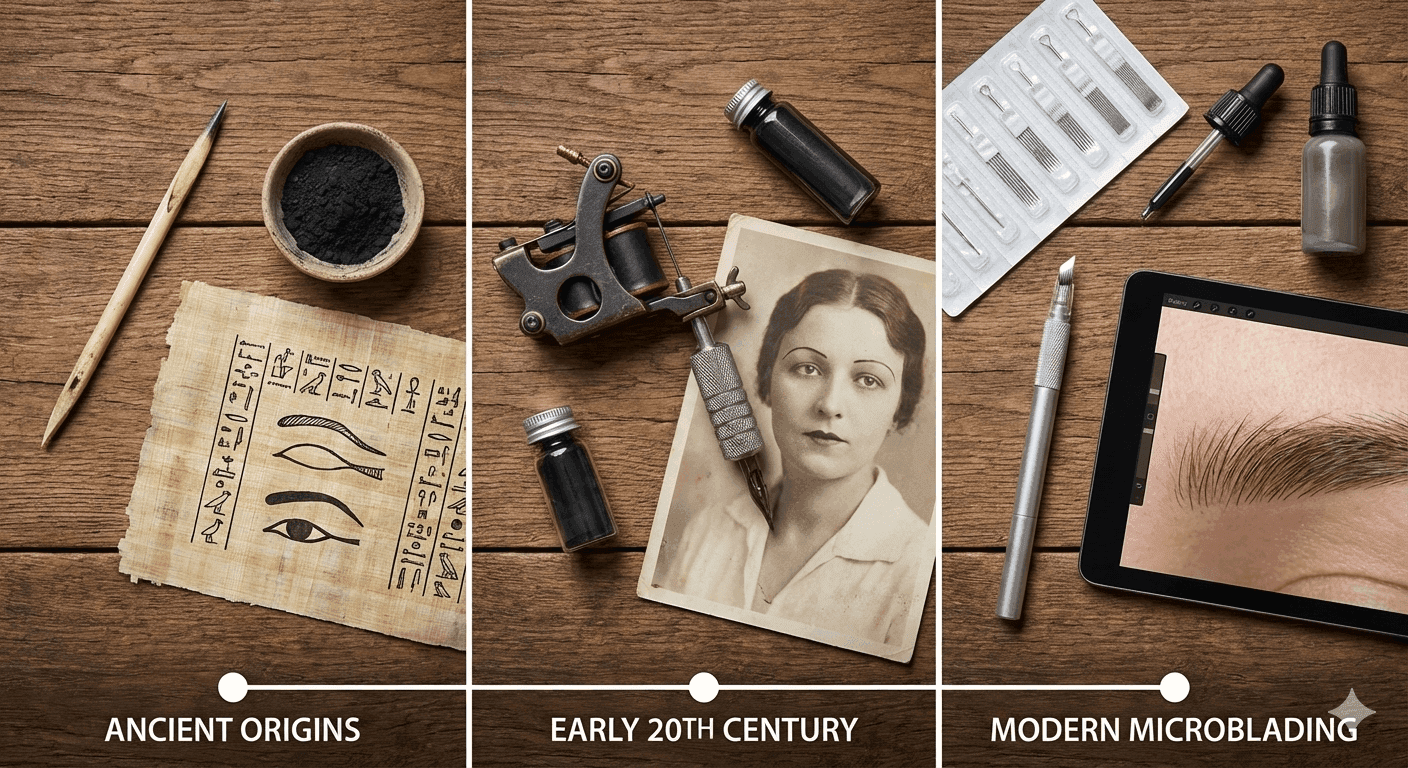
People have been obsessing over their eyebrows for a very long time. Shapes have come and gone, trends have reversed, and every culture has had its own idea of what a "good" brow looks like. Microblading is a recent technique, but the desire behind it is ancient. Knowing where it came from actually tells you a lot about how it works and what to look for in a practitioner.
Brows Have Always Been a Big Deal
Long before anyone had a hand tool and a pigment palette, people were shaping and filling their brows with whatever was available. Ancient Egyptians used kohl, a mineral-based mixture, to darken and extend their brows as part of a broader eye treatment. It wasn't just cosmetic either. Brow definition carried religious and social meaning.
In ancient China and Japan, women plucked their brows entirely and painted new ones higher on the forehead. The ideal shape changed across dynasties, but the intent was always the same: a deliberate, defined brow that communicated something about the wearer. That cultural attention to brow aesthetics in Asia is directly connected to where modern microblading eventually came from.
Where the Technique Actually Started
The method closest to what we do today originated in Asia, specifically in China, Japan, and parts of Southeast Asia, sometime in the latter half of the 20th century. Early practitioners used a manual tool fitted with fine needles to place pigment just under the skin's surface in short strokes that mimicked individual hairs. The goal was a natural look, not a solid filled-in brow.
In Singapore, South Korea, and Thailand, this was often called "eyebrow embroidery," and it became a popular salon service through the 1980s and 1990s. The tools were rougher, the pigments less consistent, and training was largely informal. But the core idea was already solid.
How It Made Its Way West
Microblading didn't arrive in the U.S. overnight. It filtered into Europe and North America gradually through the 2000s, mostly through beauty professionals who trained abroad and brought the technique back with them. By the early 2010s it was starting to surface in Western studios, though it was still inconsistently practiced and not widely regulated.
The name shifted as it crossed markets. "Microblading" became the standard English term, probably because it describes the tool itself: a small, blade-shaped cluster of micro-needles. For a while, "feathering," "hair stroke brows," and "3D brows" were all floating around as interchangeable terms, which made it genuinely confusing for clients trying to research the service.
Then Instagram happened. Around 2015 and 2016, before-and-after photos spread fast, demand exploded, and training programs multiplied almost overnight. That growth brought more access, but it also brought a flood of undertrained artists into the market. Quality became a real problem.
What Microblading Actually Is
Microblading is a semi-permanent cosmetic tattooing technique where a manual hand tool is used to deposit pigment into the upper layers of the skin in fine, hair-like strokes. It was developed in Asia in the late 20th century and became widely practiced in Western countries during the 2010s. Results typically last one to three years depending on skin type and aftercare.
The Push for Standards
As the service grew, so did the push to regulate it. Professional organizations, training academies, and state licensing boards began developing actual curriculum and safety protocols. In the U.S., microblading falls under permanent cosmetics or tattooing regulations, and those rules vary by state. California has specific licensing frameworks covering sanitation, pigment use, and scope of practice.
That professionalization mattered more than people realize. The early wave of poorly trained artists left some clients with brows that faded to gray, blue, or red, or with strokes that blurred into muddy patches. That happened because of the wrong pigments, going too deep into the skin, or both. Better training and better pigment formulas changed outcomes significantly.
A skilled artist today understands color theory, skin undertones, facial mapping, and how different skin types hold pigment. That's not a bonus, it's the baseline for a result that actually lasts and looks right.
How the Tools Have Changed
Early manual blades were simple and inconsistent. Modern microblading tools are precision-made, with needle configurations designed for specific stroke widths and depths. Artists choose blade shape based on the client's natural brow texture, hair direction, and skin type. It's a much more considered process than it used to be.
Machine-based alternatives like nano brows and powder brows have also grown in popularity alongside the manual technique. These use a rotary machine rather than a hand tool and tend to work better for certain skin types. If you're weighing your options, Microblading vs Nano Brows: Which Technique Is Better for Your Skin? is a good read before your consultation.
Pigment formulas have improved a lot too. Early pigments were often iron oxide-based and prone to shifting color as they faded. Modern cosmetic pigments are formulated to fade more predictably, and they come in a much wider range of tones to match different hair and skin colors.
Why This History Is Still Relevant
Microblading has only been widely practiced in the U.S. for about a decade. The industry is still maturing, standards still vary, and training quality is all over the place. The artist you choose has a direct impact on your results, how long they hold up, and whether you'll need corrective work later.
Here in Thousand Oaks and the Conejo Valley, there are more options than ever, which makes it more important to ask the right questions before you book. Red Flags to Watch For When Choosing a Brow Artist is worth a look if you're still figuring out who to trust.
A technique that traveled across centuries and continents deserves to be done by someone who takes it seriously. The history of microblading is really just a long story about people wanting better brows and artists working to figure out how to deliver them. That part hasn't changed.
FAQ
How long has microblading been around? The earliest versions, sometimes called eyebrow embroidery, emerged in Asia during the 1980s and 1990s. The modern form as practiced in Western studios became widely available in the early-to-mid 2010s. So it's a young profession, even if the concept behind it is much older.
Is microblading the same as eyebrow tattooing? They're related but different. Traditional eyebrow tattooing uses a machine to push ink deeper into the dermis, which produces a more solid, longer-lasting result that's harder to fade. Microblading uses a manual hand tool to place pigment more superficially, creating finer strokes and a more natural look that fades gradually over one to three years.
Why did some early microblading results turn blue or gray? Color shifting happened when artists used pigments not formulated for cosmetic use, or when they worked too deep into the skin. Deeper placement changes how the pigment interacts with tissue and how it fades. Properly formulated cosmetic pigments applied at the right depth should fade to a softer version of the original color, not shift to something unnatural. If you're curious about this, Why Do Some Microbladed Eyebrows Turn Unnatural Colors? covers it in more detail.
Does microblading work the same on every skin type? Not exactly. Oily skin, mature skin, and very dry skin all retain pigment differently, and the healed result can vary quite a bit. Some skin types hold hair strokes beautifully. Others do better with a powder or combination technique. A thorough consultation should address this before any work is done.
How has microblading training improved? Early training was mostly informal, passed from artist to artist with little consistency. Over the past decade, dedicated academies, professional associations, and state regulations have raised the bar. Better programs now cover skin anatomy, color theory, sanitation, and technique refinement, and that shows in the results clients can expect from a well-trained artist.
Related services
Related posts

How I Got into Microblading: My Journey to Becoming a Brow Artist
Curious about microblading? Here's how my obsession with brows led me to become a microblading artist in Thousand Oaks, and why choosing the right artist really matters.
How to Handle Clients With Brow Blindness
Some clients just can't see their brows clearly, even after microblading. Here's how I help them understand their results and feel more confident with their new look.

What to Ask at Your Brow Consultation
Your brow consultation is the best time to ask the questions that protect you later. Here's what to bring up before you commit to microblading.